Retirement Plan Options for Self Employed Individuals
Building a strong retirement plan is one of the most important financial decisions a self-employed individual or small business owner can make. The right retirement plan can help turn today’s business income into long-term wealth while also providing valuable tax advantages along the way. In many cases, qualified retirement plans and IRA-based arrangements allow business owners to receive a current tax deduction or exclusion for contributions, allow those funds to grow tax-deferred, and then pay tax when the money is eventually distributed. Over time, that combination can be a powerful way to build retirement savings.
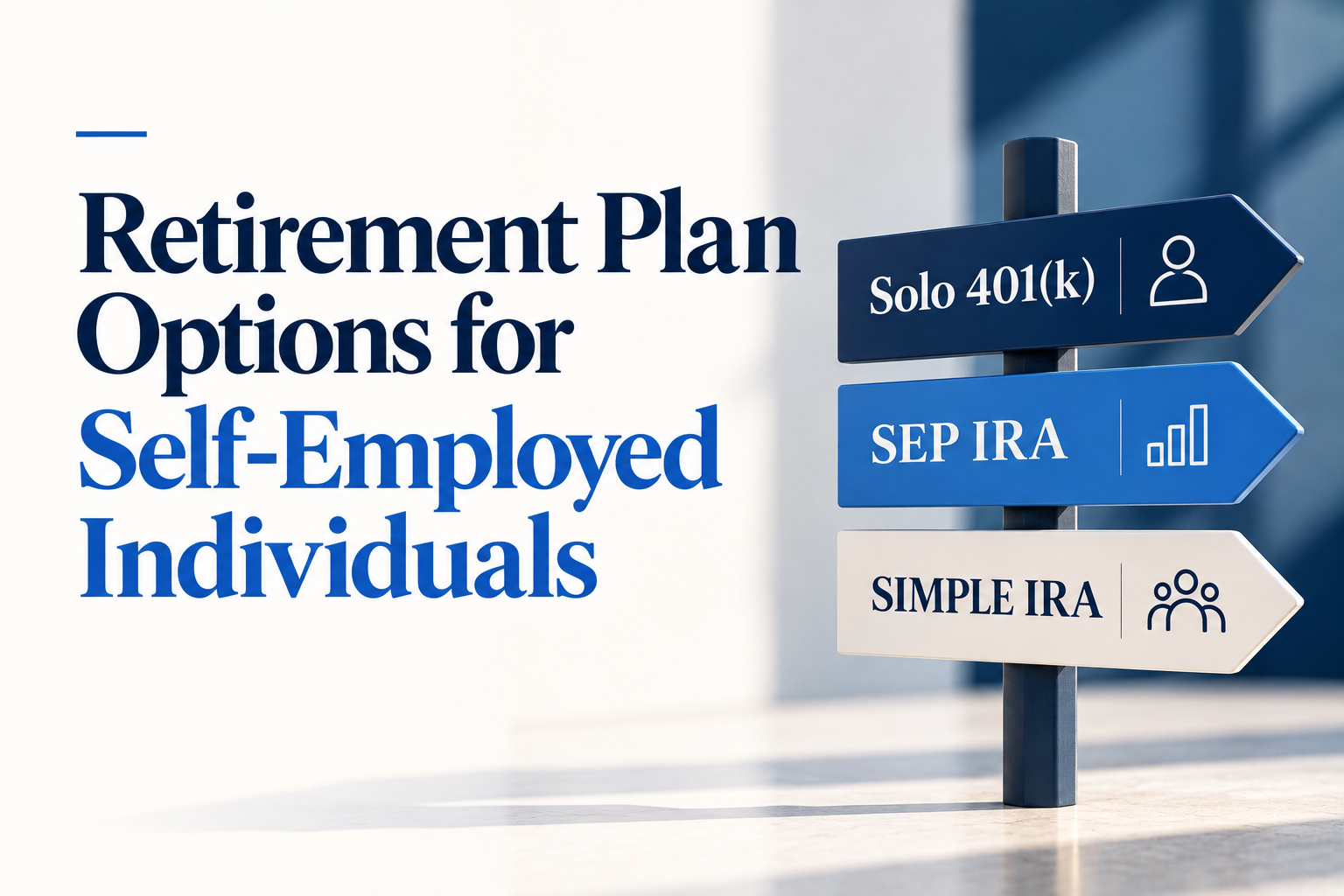
For small employers and the self-employed, three options show up again and again:
Solo 401(k) (self-employed 401(k))
A Solo 401(k) is designed for a business owner, and potentially their spouse, who does not have common-law employees. It works much like a traditional 401(k), but the business owner gets to contribute in two different roles. You can make elective deferrals as the “employee” and then make additional profit-sharing or nonelective contributions as the “employer,” with both going into your retirement account. For many higher-income self-employed individuals, this combination can allow for one of the largest annual retirement contributions available because both employee and employer contributions can be used within the applicable defined contribution limits.
SEP IRA (Simplified Employee Pension)
A SEP IRA is an IRA-based retirement plan where the business makes contributions directly into retirement accounts for eligible employees, including the business owner. Unlike a traditional 401(k), employees generally do not make salary-reduction contributions into a standard SEP. Instead, contributions are made by the employer and are subject to applicable compensation and annual contribution limits. One of the biggest advantages of a SEP IRA is simplicity. It is generally easier to establish and administer than a traditional qualified retirement plan and does not require the annual Form 5500 reporting that applies to many larger retirement plans.
SIMPLE IRA (Savings Incentive Match Plan for Employees)
A SIMPLE IRA is another IRA-based retirement plan, but it operates more like a simplified 401(k). Employees can make elective salary-reduction contributions, while the employer is required to make either matching contributions or fixed nonelective contributions for eligible employees. SIMPLE IRAs are generally available to employers with 100 or fewer employees and are designed to give smaller businesses a retirement-plan option with simpler administration, eligibility, notice, and reporting requirements.
Each of these plans can be a valuable retirement and tax-planning tool, but they are designed for different situations.
Solo 401(k)s often work well for business owners with strong self-employment income and no employees other than a spouse. SEP IRAs can be attractive for owners who want flexible, employer-funded contributions with relatively little administrative work. SIMPLE IRAs may make more sense for businesses that want employees to contribute toward their own retirement while keeping the overall plan relatively straightforward.
Because contribution limits, eligibility requirements, employer obligations, and available tax deductions depend on your specific business structure and income, there is rarely one retirement plan that is best for everyone. Choosing the right plan should be done with a qualified tax professional who understands your business, your income, your future hiring plans, and your long-term financial goals. This helps ensure that the retirement plan you choose not only provides the benefits you are looking for, but is also properly established and maintained under applicable tax rules.