What Business Owners Need to Know
The IRS recently expanded its Business Tax Account, giving eligible business owners and organizations more ways to access and manage federal tax information online.
For business owners, that means more direct access to information such as balances, payments, tax records and certain IRS notices—without necessarily having to make a phone call or wait for something to arrive in the mail.
What Can I Do With an IRS Business Tax Account?
Short Answer:
Depending on your business type and your role in the business, you may be able to view tax information, check balances and payments, access certain IRS notices and transcripts, and make federal tax payments online.
The IRS continues to expand the Business Tax Account, but the information and features available depend on both the type of business and the user's relationship to it.
What is the Business Tax Account?
Think of the Business Tax Account as an online portal for your business's federal tax information.
It is separate from the IRS Individual Online Account you may already use for your personal taxes. Business Tax Account is designed for eligible businesses and authorized individuals who need access to business tax information. The IRS announced additional features on August 6, 2026, as part of its ongoing effort to give businesses more online self-service options
What Can I Actually Use it For?
This is where the Business Tax Account can become particularly useful for business owners.
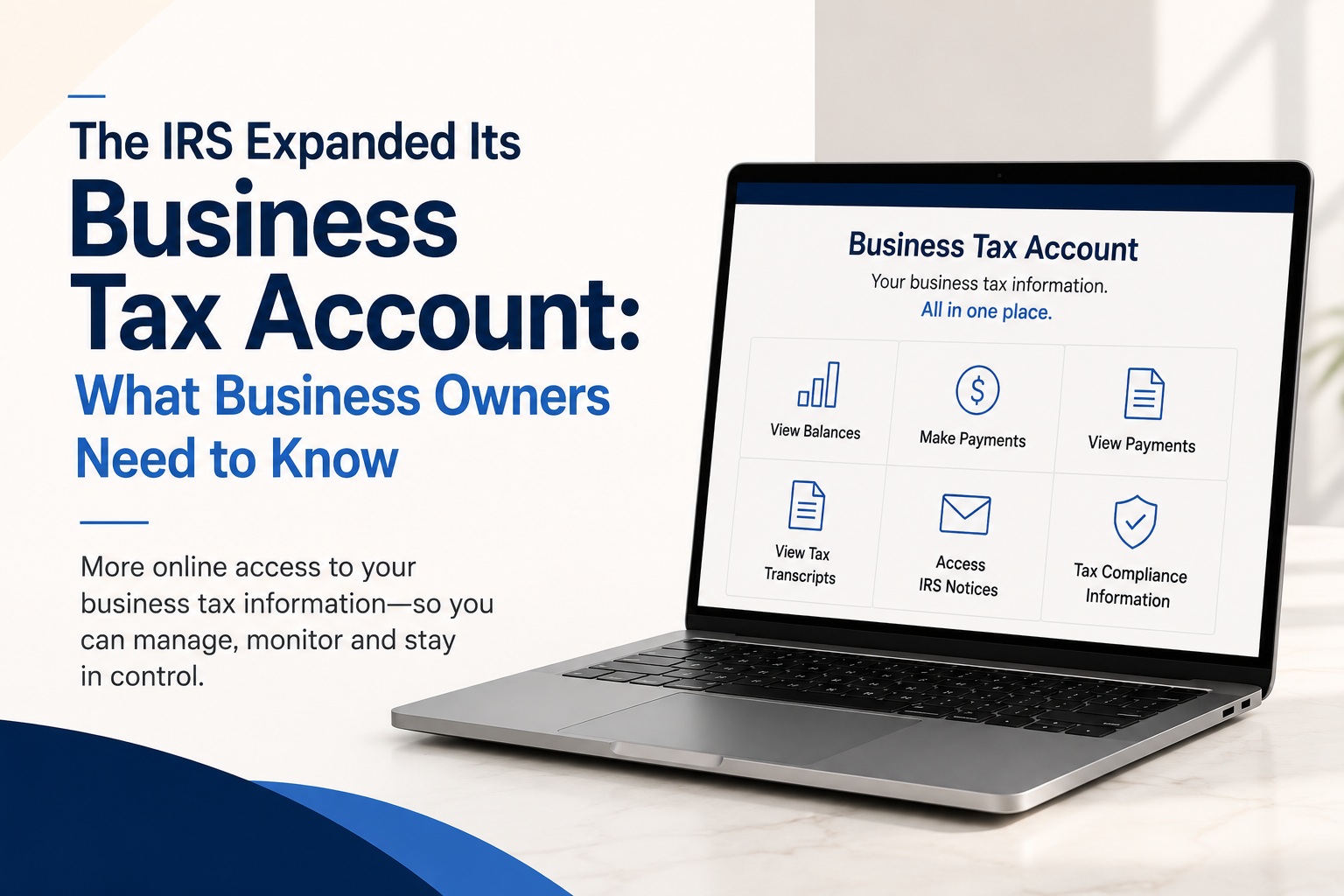
Depending on your access, you may be able to:
- View balances owed and details by tax year
- Make certain federal tax payments and federal tax deposits
- Review recently processed payments and payment history
- View and download certain business tax transcripts
- Access certain IRS notices and letters online
- View the business name and address the IRS has on file
- Access tax compliance information
- Download an EIN verification notice
- Manage certain account access and authorizations
For example, if you need business tax information for a bank, lender or CPA, having access to tax transcripts and EIN verification information may make it easier to obtain the documentation you need.
You can also use the account to check for balances related to items such as payroll taxes, past-due taxes or penalties and to find certain IRS notices associated with the business.
Quick Tip: Your Business Tax Account gives you greater access to information the IRS has about your business, but don't assume that everything you need will necessarily appear there. If something doesn't look right—or you receive an IRS notice you don't understand—have it reviewed before taking action.
Who Can Use an IRS Business Tax Account?
Not everyone associated with a business automatically has the same level of access. The IRS currently provides Business Tax Account access for several types of businesses, including eligible sole proprietors, partnerships, S Corporations and C Corporations.
Access also depends on your role.
For example, individual partners and S Corporation shareholders who meet IRS requirements may have limited access to certain business information. A qualifying Designated Official may have broader access to the business account.
For an S Corporation or C Corporation, a Designated Official generally must be an officer or managing member of the entity, be a current employee who received a W-2 for the most recent tax filing year, and have authority to legally bind the business. The IRS verifies both your identity and your relationship to the business before determining what information you are authorized to access.
What If the IRS Can't Connect Me to My Business?
If you're unable to access the account, don't automatically assume there's something wrong with the business's tax records. Business Tax Account access depends on the IRS being able to verify both who you are and your relationship to the business. Eligibility requirements also vary by business type and role.
Start by reviewing the IRS Business Tax Account eligibility requirements to make sure you're registering under the correct business type and role. If you still can't gain access, the IRS provides customer-service assistance for tax and payment questions. Keep in mind, however, that IRS customer-service representatives cannot access your Business Tax Account itself
Why Does This Matter for Business Owners?
For years, getting relatively basic business tax information could mean searching through old records, waiting for correspondence or contacting the IRS.
Business Tax Account gives eligible business owners another way to see and manage some of that information directly.
It doesn't replace your accountant or tax advisor—and having access to tax information doesn't necessarily mean you'll know what it means or what action you should take. But it does give you greater visibility into your own federal business tax information
Should I Set Up an IRS Business Tax Account?
Short Answer: If you're eligible, it's worth considering.
Having an account can make it easier to access tax records, review payments and balances, find certain IRS notices and manage other federal tax matters online. You can review eligibility requirements and create or access your account through the IRS Business Tax Account page
How Barklee Can Help
More access to your tax information is a good thing. Understanding that information is just as important.
If you see a balance, payment, notice or other information in your Business Tax Account that you don't understand, Barklee Financial Group can help you review it and determine whether any action is needed.
Having access to the information is the first step. Understanding what it means for your business is what matters.