Do I Need to Make Quarterly Estimated Tax Payments?
If you’re self-employed, own a business, receive investment income, or earn other income that doesn’t have taxes withheld, you may need to make estimated tax payments during the year. The key is understanding that federal income taxes are generally pay-as-you-go. You don’t necessarily get to wait until you file your tax return to pay everything you owe.
Short Answer: MAYBE
Generally, if you expect to owe at least $1,000 in federal tax when you file your return after subtracting withholding and refundable credits, you may need to make estimated tax payments during the year. This commonly applies to self-employed individuals, sole proprietors, partners, S corporation shareholders, and people who receive income that doesn’t have enough tax withheld.
Why Would I Need to Pay Taxes During the Year?
The federal tax system is designed so that taxes are paid as income is earned. If you’re an employee, this usually happens automatically because your employer withholds taxes from your paycheck. But if you’re self-employed or receive other income without withholding, no one is automatically sending those tax payments to the IRS for you. Estimated payments allow you to pay those taxes throughout the year instead of waiting until you file your return. Estimated payments may cover both income tax and self-employment tax, including Social Security and Medicare taxes.
How Do I Know How Much to Pay?
This is where estimated taxes can become a little more complicated. The amount you should pay depends on your expected income, deductions, credits, withholding, and other factors for the year. Generally, taxpayers can avoid an underpayment penalty by paying enough during the year through withholding and estimated payments to meet IRS requirements. Those requirements are generally based on either the current year’s expected tax or the previous year’s tax, with different rules applying to some higher-income taxpayers.
If your business income changes significantly during the year, your estimated payments may need to change too.
Keep in Mind: Estimated payments aren’t necessarily something you calculate once in January and forget about. If your income goes up or down significantly during the year, it may be a good idea to revisit the amount you’re paying.
When Are Quarterly Estimated Tax Payments Due?
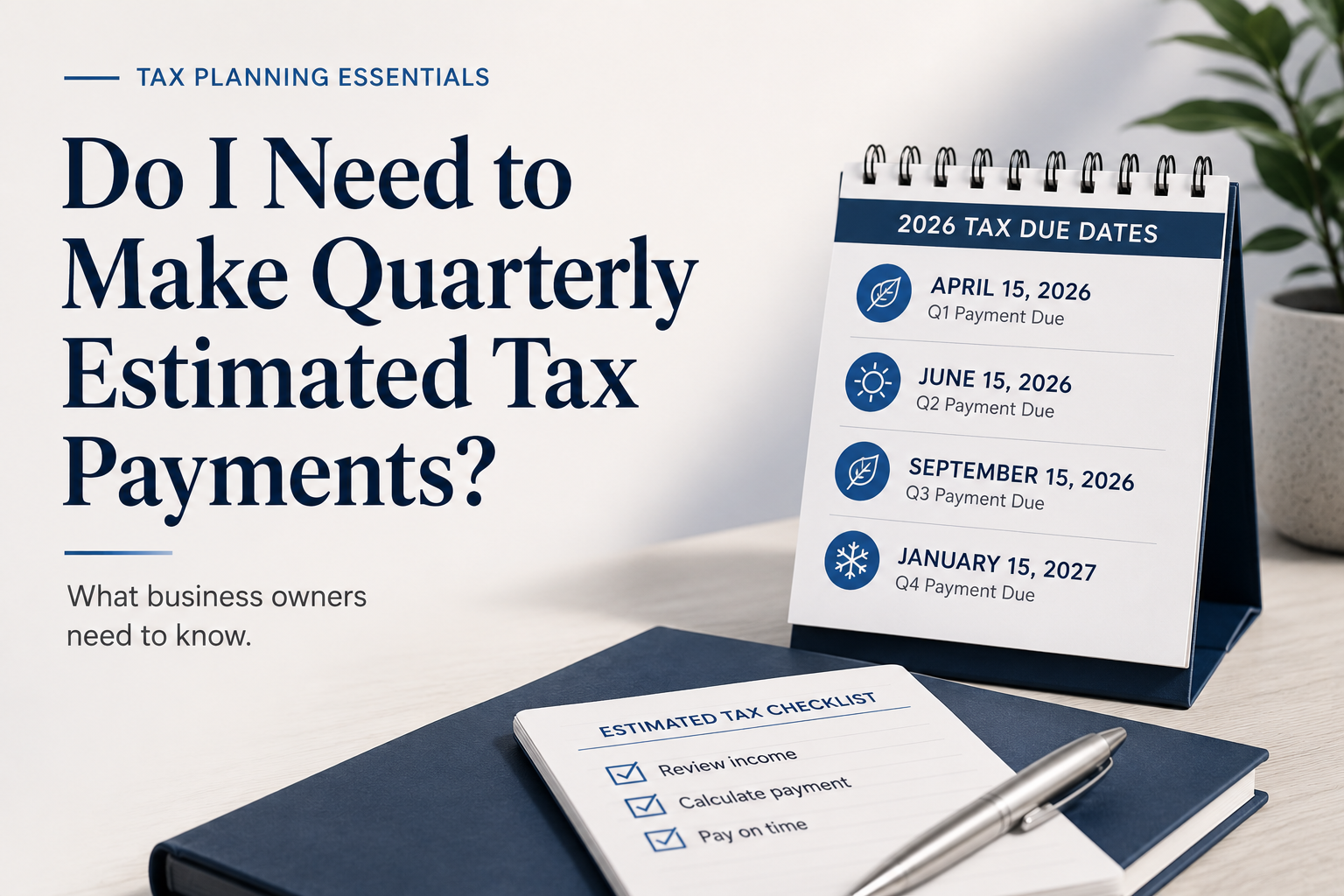
For most calendar-year taxpayers, estimated payments are generally due four times a year.
For 2026, the due dates are:
- April 15, 2026
- June 15, 2026
- September 15, 2026
- January 15, 2027
If a due date falls on a weekend or legal holiday, the deadline generally moves to the next business day.
What Happens If I Don’t Pay Enough?
If you don’t pay enough tax throughout the year—or you make required payments late—you may owe an underpayment penalty.
And here’s something that sometimes surprises taxpayers: you can potentially owe an underpayment penalty even if you’re due a refund when you eventually file your tax return. That’s why tax planning during the year can be just as important as preparing the return at the end of it.
What If My Income Isn’t the Same Every Month?
For many business owners, income isn’t predictable. You might have a strong first quarter, a slow summer, and a very profitable fourth quarter. Or you may land a large client or contract halfway through the year that changes your income significantly.
That doesn’t mean you should simply ignore estimated taxes until next April.
If your income changes during the year, talk with your tax advisor about whether your estimated payments should be adjusted. In some situations, the timing of when income is earned can also affect how estimated tax requirements are calculated.
What Should I Do Now?
If you have income that isn’t subject to withholding, don’t wait until tax-filing season to find out whether you’ve paid enough.
Review your income and tax situation during the year, particularly if:
- Your business is growing
- Your income has increased significantly
- You started a business or became self-employed
- You became an S corporation shareholder
- You received significant investment or other income
- You owed a large balance when you filed your last tax return
A mid-year tax review can help determine whether you’re on track or whether your estimated payments need to be adjusted.
How Barklee Can Help
Quarterly estimated taxes shouldn’t be a guessing game. Barklee Financial Group can review your income, withholding, business activity, and prior-year tax information to help determine whether estimated payments are necessary and how much you should be paying. If your income changes during the year, we can also help you revisit those estimates so you aren’t caught off guard when it’s time to file your return. The goal isn’t simply to make four payments a year. It’s to understand what you’re likely to owe and plan for it before tax season arrives.